
She brings the complexity of agriculture together in models
Iris Vogeler has spent her career translating the realities into models. As a newly appointed professor at Aarhus University, she wants to use them to develop solutions that work in practice while accounting for the bigger picture.
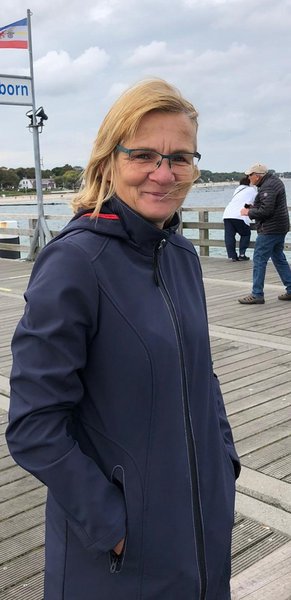
There is not necessarily soil under Iris Vogeler’s fingernails when she goes to work. Instead, she carries fields, farms, and landscapes in her mind as systems that can be adjusted, connected, and understood.
As a professor at the Department of Agroecology at Aarhus University, she works with models designed to capture the complexity of reality: how nitrogen, climate, carbon, economics, and farmers’ decisions interact. Not only in theory, but in practice.
“We often focus too narrowly on one thing at a time,” she says. “But in reality, everything is connected. If you turn one knob, the rest of the system moves as well.”
This holistic perspective has accompanied her throughout a long and international research career from studies in Germany, through many years in New Zealand, and now to Denmark. Here, models are once again in play, this time in an agricultural sector under intense pressure to deliver both food and solutions to climate and environmental challenges.
From horticulture to systems thinking
Iris Vogeler’s interest in soil and plants began in Germany, where she grew up and later studied horticulture. Her education combined soil science, plant nutrition, and economics, but it was the processes in the soil that fascinated her most.
A lecturer introduced her to modelling at the time in very simple forms.
“Compared to today, the models were primitive,” she says. “But for me, they opened up an entirely new way of understanding connections. Suddenly, you could experiment with a system without being limited to a single field or a season.”
As part of her studies, she completed her final project at Massey University in New Zealand. There, she worked on modelling nutrient transport in soils, initially without crops. The stay proved decisive.
She was encouraged to continue with a PhD.
“I liked both the research and the place,” she says. “So, I said yes.”
A career built around models
Her PhD marked the beginning of a long research career in New Zealand first as a postdoctoral researcher and later in permanent positions within a research system operating at the intersection of universities and government research institutions.
Over time, she progressed from junior to senior researcher, alongside family life and periods of part-time work experiences that have also shaped her views on leadership and mentoring today.
Scientifically, her focus gradually shifted from horticulture to grass-based production systems. This was driven in part by the fact that New Zealand’s most pressing environmental challenges are closely linked to dairy, sheep and beef farming.
It was here that she began working intensively with the APSIM model: an advanced simulation tool that links crop growth, soil processes, climate, and management.
“I’ve spent a large part of my career developing models further,” she says. “Either by adapting them to new crops or by integrating new processes to make them more realistic.”
From New Zealand to Aarhus
After many years on the other side of the globe, the desire for change emerged both professionally and personally. When she saw a job advertisement from Aarhus University in 2018, it matched her expertise precisely: modelling of cropping systems, environmental impacts, and nitrogen cycles.
She applied... and got the job.
Today, she uses models as analytical tools to understand and evaluate complex issues such as precision fertilisation, alternative land use, carbon storage in soils, and the interactions between climate, production, and the environment.
Models are not answer keys, she emphasises, but ways of improving the quality of decision-making.
Finding solutions, not just numbers
What drives Iris Vogeler is the ambition to contribute solutions that can actually be used, not perfect answers, but better foundations for choice.
“The environmental challenges are enormous not only in Denmark, but globally,” she says. “And we need to consider several things at once: nitrogen leaching, greenhouse gases, carbon sequestration, and economics.”
She is currently involved in projects on land set-aside and alternative land use in vulnerable areas: Which measures deliver the greatest climate and environmental benefits and where? And can pressure be reduced without disproportionately large economic losses?
At the same time, she is engaged in European projects working to harmonise methods for carbon accounting and carbon credits: a field characterised by great complexity and considerable uncertainty.
“It’s extremely challenging,” she says. “But also necessary if models and measurements are to be used in practice and inspire trust.”
Professor and sparring partner
For Iris Vogeler, being a professor is not only about publications and projects, but also about people. She places strong emphasis on supervision and collaboration with PhD students and postdocs.
“I see it as a mutual learning space,” she says. “I bring experience and systems understanding, but younger researchers are often much faster with programming and new technologies. We learn from each other.”
For her, mentoring is a central part of the professorship: creating a sense of security in a complex field and helping younger researchers navigate a world in which modelling plays an increasingly important role in both research and policy.
Looking ahead
According to Iris Vogeler, the future points towards even closer integration of models and data—particularly through satellites, drones, and other forms of remote sensing. Not to control agriculture, but to understand it better.
“Farmers already have plenty to deal with,” she says. “If we can obtain more information directly from observations, models can improve and solutions can become more realistic.”
Perhaps this is where the picture of Iris Vogeler as a researcher comes together: a professor who insists on holism, patience, and systems thinking and who uses models not as abstractions, but as tools for creating real change in an agricultural sector under pressure.
Contact:
Professor Iris Vogeler, Department of Agroecology, Aarhus University. Tel.: +45 20755932 or mail: iris.vogeler@agro.au.dk
Communications advisor Camilla Brodam Galacho, Department of Agroecology, Aarhus University. Tel.: +45 93522136 or mail: brodam@agro.au.dk