
Annual bluegrass challenges Danish agriculture
Resistance to ALS herbicides is spreading in Danish fields and has already been documented for several grass-weed species. Now new research shows that the resistance problem in annual bluegrass is more complex than previously assumed, and that the solution requires a combination of non‑chemical control and long‑term strategies.

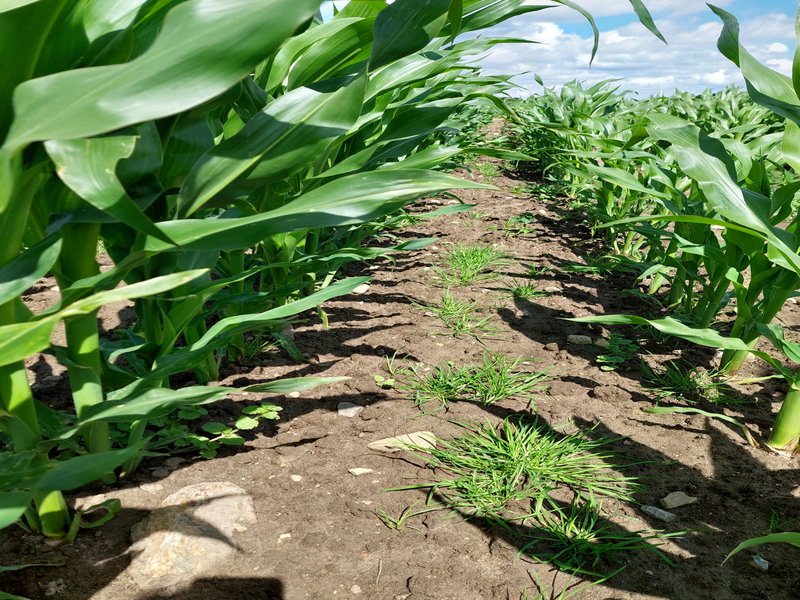
It looks harmless. Small green tufts between maize rows that hardly seem problematic at first glance. But beneath the surface, a major issue for Danish agriculture is growing. Annual bluegrass (Poa annua) has developed resistance to some of the most commonly used herbicides, and this is happening not just in one place, but in many locations independently of each other.
“We have seen a significant rise in resistance cases since 2015,” says Mette Sønderskov from the Department of Agroecology at Aarhus University. “The problem is particularly severe in maize and seed grass, but we also find resistance in cereal crops. It’s worrying because we are losing one of our most important weed‑control tools.”
When chemistry stops working
For decades, ALS herbicides have been a cornerstone in controlling grass weeds in seed grass and cereal crops. However, intensive and repeated use has increased selection pressure and the consequences are now visible. The project “Biology and management of herbicide resistance in Poa annua”, funded by the Danish Environmental Protection Agency’s pesticide research programme, has documented that resistance is widespread and develops locally and independently.
In seed grass, diflufenican has been used to keep annual bluegrass under control, but with the ban on this active ingredient, seed production loses an important alternative to ALS herbicides.
“Even more concerning is the high occurrence of metabolic resistance, which we have now also confirmed in collaboration with the University of Copenhagen,” explains Mette Sønderskov. This type of resistance does not make just one herbicide ineffective, it reduces the effect of several modes of action. This significantly narrows the options for chemical alternatives and increases the need for non‑chemical methods.
What the project uncovered
Researchers collected populations of annual bluegrass from across Denmark and analysed resistance mechanisms. The results show:
- Resistance develops locally: selection pressure in the individual field is crucial.
- Most resistant populations lack known ALS mutations and are considered metabolically resistant.
- Mechanical control works in maize: a strategy combining false seedbed and early inter-row weeding with finger weeders achieved almost the same effect as a pure herbicide strategy. However, mechanical control is more vulnerable to difficult weather and soil conditions.
- Crop choice has limited impact: spring barley and oats are slightly more competitive than spring wheat, but crop choice alone cannot solve the problem. Establishment timing is the key factor.
- Seedbank dynamics are critical: seeds can survive in the soil for several years. After heavy seed shedding, fields should remain untilled for at least two years, preferably longer, to effectively reduce the seedbank.
What does this mean in practice?
“If we continue as usual, we risk losing control of annual bluegrass and with it, the production of seed grass and maize,” says Mette Sønderskov. She explains that a focused effort is needed:
- Early monitoring and planning: resistance develops at field and farm level, giving the farmer significant influence.
- Combination strategies: mechanical control, adjusted sowing dates and strategic ploughing.
- In seed grass production: it is crucial to control annual bluegrass in the crop rotation between seed grass years.
- Long‑term seedbank management: avoid ploughing for two years after heavy seed shedding to reduce the seedbank.
“We need to get used to the idea that there is no single solution. It’s about combining multiple approaches and thinking long‑term. This applies not only to annual bluegrass,” says Mette Sønderskov .
Want to know more?
Senior Advisor Mette Sønderskov, Department of Agroecology, Aarhus University
Phone: +45 3957 2128 · Email: mette.sonderskov@agro.au.dk
Communications Advisor Camilla Brodam Galacho, Department of Agroecology, Aarhus University
Phone: +45 9352 2136 · Email: brodam@agro.au.dk