
Understanding soil before we can protect it
From a French university student fascinated by soil to a professor at Aarhus University. For Mathieu Lamandé, research is not only about soil structure and heavy machinery. It is about creating knowledge that people can use.
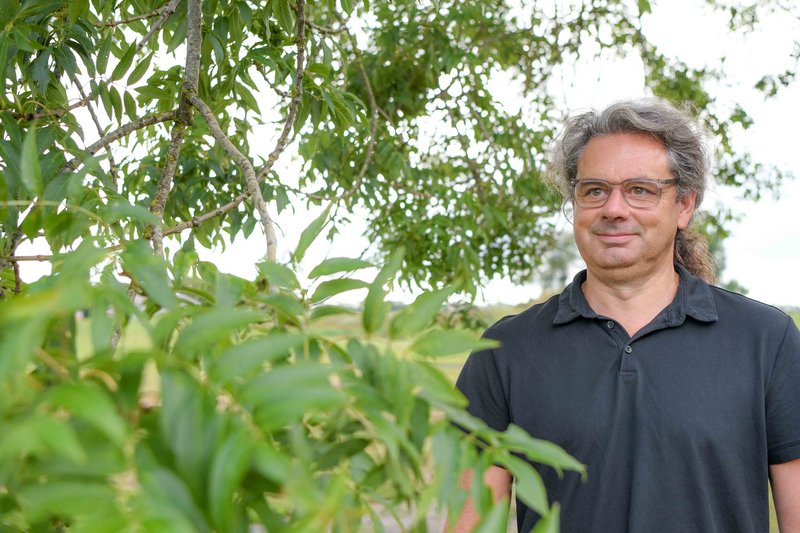
When Mathieu Lamandé talks about soil, he does so with an enthusiasm that is almost instantly contagious. To him, soil is not merely the layer beneath our feet. It is the foundation of food production, a cornerstone of the water cycle, and a key piece in addressing some of the greatest climate challenges society faces today.
"If you have poor soil structure, you won't produce food. It's really that simple," he says.
Today, he is a professor at the Department of Agroecology at Aarhus University, but his fascination with soil began much earlier, while he was a student in his native France.
Inspiring teachers showed the way
Growing up in France, Mathieu Lamandé initially studied geology. At the time, he did not necessarily have a clear plan to become a soil scientist. But encounters with inspiring teachers changed his direction. In particular, courses on soil organization and organic matter left a lasting impression.
"The teaching was very pedagogical, and I found it incredibly fascinating," he recalls.
His interest deepened throughout his studies, and after completing his master's degree, he moved directly into a PhD programme focusing on soil structure, earthworms, and agricultural practices.
"I started university at 18, and eight years later I had completed my PhD," he says.
A 700-kilometre journey and a new beginning
Before he had even submitted his doctoral thesis, he had already secured a postdoctoral position in eastern France. Shortly afterwards came the next major step. A Danish researcher was looking for a postdoctoral fellow, and through professional networks, Mathieu Lamandé was recommended for the position.
In 2004, he moved to Denmark.
The plan was not necessarily to stay. But that is how things turned out.
"I've ended up sticking around," he says with a smile.
Since then, he has built his entire research career in Denmark, progressing from postdoctoral researcher through senior academic positions to professor.
Searching for soil's invisible structure
Ask Mathieu Lamandé what he actually researches, and the answer is not entirely straightforward. Soil structure is connected to almost everything.
His work explores how soil structure is affected by agricultural practices, forestry, tillage, plant roots, earthworms, frost, and heavy machinery.
At its core, soil structure is about how soil is organised and how well it can withstand the pressures placed upon it. When the structure is damaged, the consequences can be far-reaching. Water drainage becomes less efficient, plant roots struggle to develop and access water and nutrients, and the soil's capacity to store carbon and reduce greenhouse gas emissions is diminished.
That is why soil structure is not merely a concern for researchers. It is a question about the future of agriculture.
Challenging long-held theories
One of the things that continues to motivate Mathieu Lamandé is the opportunity to question established truths.
Early in his career, he conducted a large-scale experiment to test a theory from 1885 describing how stresses move through soil. The theory had been used for decades but had never been thoroughly validated in practice.
The results showed that the theory worked well in subsoil layers, but less well closer to the surface.
Those are the kinds of questions he still pursues today.
In fact, the scientific paper he is most proud of is founded on the same principle: challenging methods that researchers have relied on for nearly a century. Together with his mentor, Per Schjønning, now Professor Emeritus, he has worked on developing a new way of describing soil strength. The approach could improve assessments of when soil is capable of supporting heavy machinery without suffering damage.
Turning research into practice
For Mathieu Lamandé, research only becomes truly valuable when it can be applied beyond the walls of the university.
That is why he places great emphasis on translating scientific findings into practical tools that farmers and advisors can use.
Since 2006, he has helped develop decision-support tools based on research data that can reduce the risk of soil compaction. And practical application is crucial.
"It is important that our results make their way into practice so that someone can actually use them," he says.
Fact box: What is soil structure? Soil structure describes how soil particles are arranged and how the pore spaces between them are distributed. Good soil structure makes it easier for plant roots to grow, improves the soil's ability to absorb and store water, and reduces the risk of soil compaction. At the same time, soil structure influences nutrient cycling, carbon storage, and greenhouse gas emissions. |
The next generation
Although research occupies much of his time, teaching remains an important part of life as a professor for Mathieu Lamandé.
In many ways, he sees himself in today's students. After all, it was an engaged and inspiring teacher who first set him on the path toward soil science many years ago.
Now he hopes to do the same for others.
"If a student says at the end of a semester, 'This was actually really interesting,' then all the effort is worth it," he says.
That is also why he devotes a great deal of time to supervising students and early-career researchers.
Making a difference
When asked what he would like to be remembered for, Mathieu Lamandé's answer has little to do with professorships, publications, or scientific awards. He would much rather be remembered as someone who helped others.
"I would like to be known as the researcher who helped people in their work and who did something useful for farmers," he says.
Perhaps that is the thread that runs through his entire career.
From those first lectures in France to his professorship at Aarhus University, a fascination with soil has been the driving force. Yet the goal has always extended beyond research itself: to create knowledge that makes a real difference, both for people and for the soil on which we all depend.
Contact
Professor Mathieu Lamandé, Department of Agroecology, Aarhus University. Tel.: +45 22240870 or e-mail: mathieu.lamande@agro.au.dk